Latest News
We are thrilled to announce that UniTO and EIDOS Lab have officially joined the European Laboratory for Learning and Intelligent Systems (ELLIS), one of Europe’s leading AI research networks dedicated to fundamental research in machine learning and its applications.
Our group is now part of the ELLIS Unit Turin, which brings together top researchers from ISI Foundation, LINKS Foundation, Politecnico di Torino and University of Turin to advance excellence in AI and machine learning research at a European level.
Being part of ELLIS connects us to a vibrant community of researchers across Europe, opening new opportunities for collaboration, student exchanges, and joint research initiatives. We look forward to contributing to the ELLIS mission and to strengthening the ties between our group and the broader European AI research community.


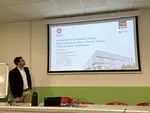
Congratulations to Alberto Presta for successfully defending his PhD thesis, titled " Toward sensible learned image compression: closing the gap with standard codecs".
Abstract: This thesis explores limitations of current Learned Image Compression (LIC) models, particularly their inability to support multiple bitrates, progressive coding, and adaptability to unfamiliar domains—challenges not shared by traditional codecs. To address these, we introduce methods such as a parameter-free latent distribution formulation, a graph-based context estimator, and two solutions for variable rate coding: a quantization layer (STanH) and LoRA adapters for transformers. The work also proposes a dual-latent architecture for progressive compression and decoder-based domain-specific modules that enhance performance without retraining, with promising extensions to video compression.
The committee was composed by:
- Giuseppe Valenzise, CNRS Researcher, CentraleSupélec Gif-sur-Yvette, France
- Marco Cagnazzo, Dip. di Ingegneria dell’informazione, Uni Padova
- Gabriella Olmo, Dip Informatica, Polito
- Davide Cavagnino, Dip. Informatica, Unito
PhD Supervisor: Marco Grangetto (University of Turin)
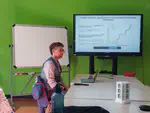
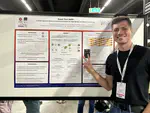
🌟 We had a fantastic time participating in the European Conference on Computer Vision (ECCV24), one of the top conferences in computer vision! It was a pleasure attending the event and catching up with old and new colleagues. 🤝
We’re also excited to announce that two of our papers were accepted:
📄 Boost Your NeRF: Project page Francesco Di Sario Riccardo Renzulli Enzo Tartaglione Marco Grangetto
📄 AA-SGAN: Project page Mirko Zaffaroni Federico Signoretta
Excited for what’s next! 🚀
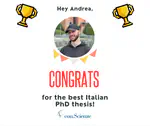
EIDOS is very proud to announce that Andrea Bragagnolo, who got his PhD in our group, received the award for “Best Italian PhD Thesis 2023” assigned by con.Scienze. The title of his thesis is “Exploring the Design and Implementation of Pruning Techniques for Deep Neural Networks”.
Congratulations Andrea!
Congratulations to Ayesha Hoor Chaudhry for successfully defending her PhD thesis, titled “Medical Volumetric Image Processing With Deep Neural Networks”.
The committee was composed by:
- Prof. Davide CAVAGNINO – Computer Science Dept. - University of Turin;
- Prof. Sinem ASLAN – Dept. of Environmental Sciences, Informatics and Statistics – Ca’ Foscari University of Venice;
- Prof. Maurizio MARTINA – Dept. of Electronics and Telecommunications – Polytechnic of Turin;
PhD Supervisor: Marco Grangetto (University of Turin)
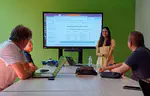
EIDOS is very proud to contribute to ISBI 2024 with paper:
- AI-Assisted Diagnosis for Covid-19 CXR Screening: From Data Collection to Clinical Validation by Carlo Alberto Barbano (University of Turin, Télécom Paris), Riccardo Renzulli (University of Turin), Marco Grosso (ASL Torino 3), Domenico Basile (ASL Torino 3), Marco Busso (ASL Torino 3), Marco Grangetto (University of Torino)
Congratulations to Carlo Barbano for presenting his work.
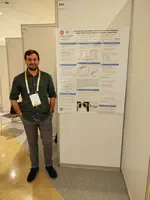
Marco Grangetto special guest on the RBL channel EULERO show, talking about Computer Vision and prejudice.
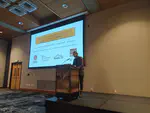
EIDOS is very proud to contribute to DCC 2024:
- Domain Adaptation for Learned Image Compression with Supervised Adapters by Presta, Alberto; Spadaro, Gabriele; Tartaglione, Enzo; Fiandrotti, Attilio; Grangetto, Marco;
Congratulations to Alberto Presta for presenting his work with an amazing oral talk.
The Data Compression Conference (DCC) is an international forum for current work on data compression and related applications.
Congratulations to Carlo Alberto Barbano for successfully defending his PhD thesis, titled “Collateral-Free Learning of Deep Representations: From Natural Images to Biomedical Applications”. The committee awarded his defense with honors.
The committee was composed by:
- Prof. Daniel RUECKERT – Dept. Computing - Imperial College London;
- Prof. Hervé LOMBAERT - ETS Montreal;
- Prof. Rosa MEO – Dip. Informatica – Università di Torino;
- Prof. Enrico MAGLI – Dip. Elettronica e Telecomunicazioni – Politecnico di Torino;
- Prof. Isabelle BLOCH - Télécom Paris – Institut Polytechnique de Paris;
- Prof. Marco GRANGETTO - Dip. Informatica – Università di Torino;
- Prof. Pietro GORI - Télécom Paris – Institut Polytechnique de Paris …
PhD Supervisor: Marco Grangetto (University of Turin), Pietro GORI (Télécom Paris – Institut Polytechnique de Paris), Isabelle BLOCH (Télécom Paris – Institut Polytechnique de Paris)